| |
|
 |
|
(Under
Construction)
|
|
While history furnishes a wealth of motivation, we are confident that
new avenues and designs await development. As surely as we must be inspired
by the triumphs of the past, we must face the challenges of today, by
building organs which reflect the interests, tastes and sensibilities
of modern culture. Copying old formulas may be fashionable for some, but
it is hardly artistic or creative - art is only Art when it represents
the best efforts of its own good time.
|
| |
|
The famous Spreckels outdoor organ at Balboa
Park,
San Diego, California; Opus 453: |
| |
| This organ was built in 1914. Financed by John D. Spreckels,
and given to the city of San Diego to celebrate the Panama California Exposition,
it has been played by organists from Marcel Dupre to Virgil Fox and is still
played on a regular basis. |
| |
|
For more information contact:
SPRECKELS ORGAN SOCIETY
1549El Prado, Suite 10
San Diego, California 92101-1661
Tel. (619) 702-8138
Fax.(619) 702-8128
Web Site: www.serve.com/sosorgan
E-mail: Sosorgan@aol.com
|
 |
| |
|
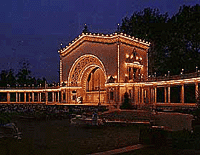
| The Panama Pacific Organ, San Francisco,
California; Opus 500: |
| |
|
 |
This photograph depicts Opus 500 which was built in 1915 for
the Panama-Pacific Exposition in San Francisco. The four manual instrument
contains well over 100 stops including three full length 32 foot ranks,
25 reeds, and a Tuba Magna voiced on 25 inches of wind. After the exposition,
the organ was moved to the then new Civic Auditorium. In 1989, the organ
was rather significantly damaged by the earthquake. |
| |
|
|
Subsequently, the City of San Francisco signed a contract with Austin
Organs, Inc. to fully repair the organ while the building undergoes an
extensive seismic retrofit. After two years the contract was reviewed,
and the organ returned to San Francisco in installable condition; however,
it remains in storage.
|
| |
|
| The Kotszchmar Organ at Portland City Hall,
Portland, Maine; Opus 323: |
| |
|
| This organ is perhaps the finest of many municipal organs
built by Austin in the first third of this century. The orchestral nature
of the instrument makes it ideal for use with a symphony or for the playing
of transcriptions. |
| |
| During a renovation in the 1960's the organ
was moved 15 feet back from its original location. The structure of an Austin
allowed this to be done en masse, even leaving some of the pipework in place.
|
 |
| |
|
|
The organ has recently undergone a major overhaul, and has been re-installed
in a newly refurbished auditorium. The inaugural recital was held on May
5, 1997. It was also the subject of an article and cover in the November
1997 "The American Organist" magazine.
|
| |
|
|
The Curtis Organ at Irvine Auditorium,
University of Pennsylvania; Opus 1416:
|
| |
|
 Held
in Philadelphia in 1926 to celebrate the 150th anniversary of the signing
of the Declaration of Independence, the Sesqui-Centennial International
Exposition was conceived on a grand scale. Music was to play an important
part in the festivities and a suitably grand auditorium was designed. A
committee of five Philadelphia organists drew up the specification: Henry
S. Fry, John McE. Ward, Rollo F. Maitland, Federick Maxson, and S. Wesley
Sears. Held
in Philadelphia in 1926 to celebrate the 150th anniversary of the signing
of the Declaration of Independence, the Sesqui-Centennial International
Exposition was conceived on a grand scale. Music was to play an important
part in the festivities and a suitably grand auditorium was designed. A
committee of five Philadelphia organists drew up the specification: Henry
S. Fry, John McE. Ward, Rollo F. Maitland, Federick Maxson, and S. Wesley
Sears. |
| |
|
|
A contract was signed on January 27, 1926 with the Austin Organ Company
for
what was to be Opus 1416. Conceived on a scale to match that of the 10,000
seat auditorium, Opus 1416 is impressive by any measure. With 4 manuals,
162 ranks, and 10,719 pipes, it is the largest instrument built by Austin
at one time and under one contract.
The organ is now installed in the University of Pennsylvania's Irvine
Auditorium which has just undergone a complete renovation. Austin Organs,
Inc. removed all of the pipework from the organ for restoration and storage
in Hartford in the summer of 1997. The organ was then sealed for three
years while work on the auditorium was underway.
Work on Opus 1416 is now rapidly progressing in the auditorium, the flue
pipes have been reinstalled, the organ has been completely reactioned,
and the percussion stops have been restored and reinstalled. A new four
manual drawknob console is under construction in the Hartford factory
and nearing
completion. The organ is scheduled to play again in the summer of 2002.
|
| |
|
| Sweetest Heart of Mary RC, Detroit, Michigan;
Opus 2: |
| |
|
| These two organs were both built at the Clough and Warren
factory in Detroit. Opus 2 is the earliest example of the Austin Universal
Air Chest system. The chests and pipework are original, though the console
is a replacement. There is a flywheel actuated hand pump mechanism as well
as an electric blower. The organ was restored by Wayne Warren of Detroit.
|
 |
| |
|
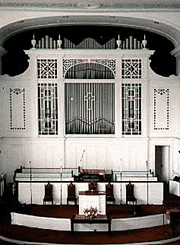 |
The Horace Bushnell
Congregational Church,
Hartford, Connecticut;
Opus 22:
Opus 22 was the last organ built by the Clough and Warren
shop, and may be the deciding factor in Mr. Austin's eventual decision
to move to Hartford. It is in essentially original condition with the
exception of periodic re-leathering.
|
| |
|
| |
|
Trinity College Chapel, Hartford, Connecticut; Opus
2536:
|
| |
| This 3 manual, 79 rank instrument is located just minutes
from the Austin factory. Built in 1971, the tonal design is French
classic. It represents the combined talent of Richard J. Piper (then
tonal director), David A. J. Broome and Clarence Watters (then organist).
The beautiful classic case and a Trompette en Chamade were added in
the 1980's. The Chapel is of the Gothic style and is actually the
chancel end of a much larger (imaginary) Cathedral. The organ occupies
an area just behind the crossing. There is a regular schedule of recitals
by well known organists, and there are several recordings available. |
|
|
|
| |
|
|
|
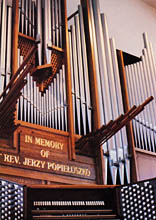
The Shrine of our Lady of Czestochowa,
Doylestown, Pennsylvania;
Opus 2719:
Installed in 1990, this 4 manual, 80 rank instrument enjoys perfect
placement in a most pleasing acoustical setting. The organ is a
memorial to The Reverend Jerzy Popieluszko, a champion of Christianity
and the Solidarity labor union. Father Popieluszko was brutally
executed in 1984.
|
|
| |
|
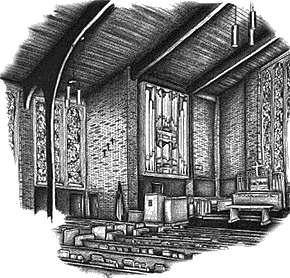
LaGrave Avenue Christian Reformed Church,
Grand Rapids, Michigan; Opus 2765:
|
| Exerpted from a review by Jeffrey Kaczmarczyk from The Grand
Rapids Press, December 2, 1996: |
|
Designed by Grand Rapids organist Jonathan Tuuk and built in a
joint venture by the Austin Organ Company of Hartford, Conn., and
Allen Organ Company of Macungie, Penn., the instrument blends some
76 ranks consisting of nearly 4,500 pipes with the latest Musical
Instrument Digital Interface electronics into an amazing organ for
the 18th, 19th, 20th, and 21st centuries.
|
 |
|
| |
|

|
|
"This is the most glorious concert organ in the state and possibly
in the Midwest," Curley said at the end of Sunday afternoon’s recital.
Though the 108-rank, five manual organ has been used at services
for a couple of weeks, it took a larger-than-life organist such
as Carlo Curley to properly introduce the larger-than-life organ
to the community.
|
|
| |
|
|
| |
|

|
|
Saint Mary's College Chapel Gallery
William & Alice Simon Memorial Organ
Moraga, California; Opus 2768:
The Austin Organ in the Chapel of Saint Mary's College, Moraga,
California, incorporates valuable historic materials from 1858 and
1902. The nucleus is an 1858 Erben organ built in New York City,
for Calvary Presbyterian Church, San Francisco.
|
|
| |
|
This organ had quite a history, traveling five months to reach San Francisco,
moving twice with the congregation to new buildings, and in 1902 undergoing
a thorough rebuilding including tubular-pneumatic action and mechanical
bowing by the eminent Los Angeles organ builder Murray M. Harris. In 1928
with the assistance of Louis J. Schoenstein, the organ was moved to the
Chapel of Saint Mary's then new campus.
Since that time, the instrument's history has been less illustrious
with alternations and patchwork repairs degrading both the organ's character
and integrity. In 1996 a contract was signed for a new Austin organ, stipulating
that the casework and finest of the existing pipes would be retained.
To that end, 19 of the 50 voices are from Erben and Harris organs, and
the central portion of the new case is the 1858 Erben facade now extended
on both sides. (Austin has had particular experience with such architectural
treatment, most notably at the Mormon Tabernacle in 1915).
While adhering to the tenets of modern tonal design, the new organ's
distinguishing feature comes in the plethora of 8 registers; there are
18 manual unison flues alone, including a wealth of flute, string and
celeste tone. Of particular note is the Harmonic Flute Celeste in the
Swell, an unusual timbre. The fundamental diet of principal and reed choruses
has not been overlooked, however with each manual and the pedal having
a fully developed plenum topped by reeds. The result is a comprehensive
new instrument, paying due reverence to its past acknowledging its own
time- and looking to the future with confidence.
|
| |
 |
| |